CELEBRATING A 25TH ANNIVERSARY WITH WILLAMETTE VALLEY VINEYARDS

CELEBRATING A 25TH ANNIVERSARY WITH WILLAMETTE VALLEY VINEYARDS

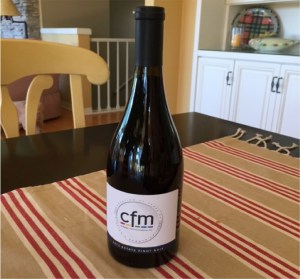
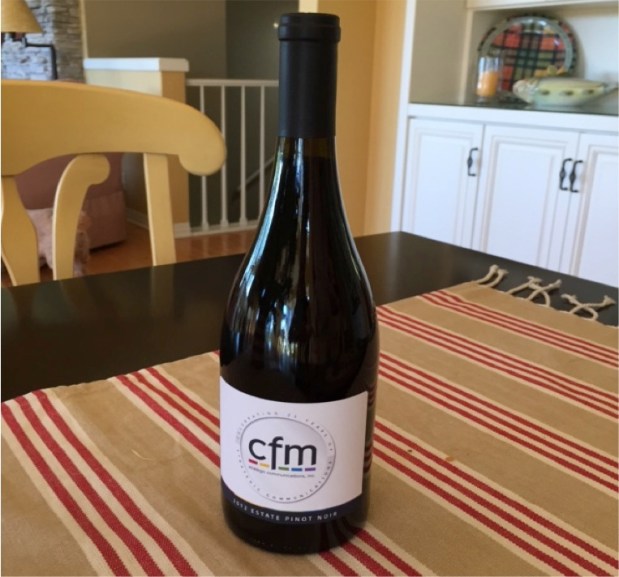
CFM wine bottleThe firm where I worked for 25 years – CFM Strategic Communications – celebrated its 25th anniversary this month by hosting a wine pairing dinner at Willamette Valley Vineyards (WVV), one of Oregon’s premier winemaking enterprises.

Actually, the president of WVV, Jim Bernau, hosted us at his establishment just south of Salem in the hills near I-5, a location which affords incredible views to the west, including the initial grapevines, which Jim planted himself about 30 years ago.

Jim, one of the most capable entrepreneurs I know, offered various reports over dinner about the wine industry in Oregon, which has prospered over the years. He peppered his comments with stories of the public policy achievements over the years by Oregon wineries, as well as about specific results by the industry in being environmentally friendly.

That was interesting news for all of us at CFM because, over the years, we have had the privilege of representing the Oregon Winegrowers Association at the Capitol in Salem, often with Jim chairing the committee with which we worked. So, we share with Jim and many other winemakers credit in Oregon for passing laws in that have allowed the industry to flourish here.

The WVV mission statement says it all: “Our mission in growing cool-climate varietals is to create elegant, classic Oregon wines from the Willamette Valley Appellation. As native Oregonians, we treasure our environment and sustainable practices in vinifying our winegrapes.”

As reported in the WVV website, Bernau, “purchased the estate site in 1983 and cleared away,” by his own hand, “the old pioneer plum orchard hidden in scotch broom and blackberry vines. He planted Pinot Noir (Pommard and Wadenswil clones), Chardonnay (Dijon and Espiguette) and Pinot Gris.  In the beginning, he hand-watered the vines with thousands of feet of hose.

“Numerous classes at UC Davis, and seminars from here to France, sharpened Jim’s viticultural skills and in 1989 he was ready to build his dream–a world class winery in the Willamette Valley—and make cool-climate varietals, especially Pinot Noir, in sufficient quantities to be served and sold in the best restaurants and bottle shops in the world.

“A combination of determination and extraordinary people has brought Willamette Valley Vineyards from an idea to one of the region’s leading wineries, earning the title “One of America’s Great Pinot Noir Producers,” from Wine Enthusiast Magazine…

“The winery and underground cellar are carved into the top of an ancient volcanic flow, the soil red from its oxidized iron content and well-drained. This unique terroir is similar to the red clay soil found in the Grand Cru Pinot Noir vineyards of Romaneé-st-Vivant in Burgundy, where the ‘soil gives France’s most perfumed, satiny, expensive wine.’”

Thus, the award winning Willamette Valley label.

We have been honored to share many of our 25 years with Jim and his colleagues, plus to enjoy wine and dinner at his fine establishment earlier this month.

If you get a chance, visit the winery yourself. You’ll be impressed by the location, the service – the best in the business in my judgment – and, of course, the fine wine.

So, Jim, here’s to another 25 years!

If you get a chance, visit the winery yourself. You’ll be impressed by the location, the service – the best in the business in my judgment – and, of course, the fine wine.

So, Jim, here’s to another 25 years!

WORDS MATTER — OR DO THEY?

[PERSPECTIVE FROM THE 19TH HOLE: This is the title I chose for my personal blog, which is meant to give me an outlet for one of my favorite crafts – writing – plus to use an image from my favorite sport, golf. Out of college, my first job was a reporter for the Daily Astorian (in Astoria, Oregon) and I went on from there to practice writing in all of my professional positions, including as an Oregon state government manager and a private sector lobbyist. This blog also allows me to link another favorite pastime – politics and the art of developing pubic policy – to what I write. If you are reading this, thanks for doing so and please don’t hesitate to respond so we can engage in a dialogue, not just a monologue.]

I have always said there are three kinds of people when it comes to receiving information in today’s society…

  • Those who like words
  • Those who like pictures and other graphics
  • Those who like numbers and charts

Of course, there are variations on the themes, as well as combinations of all three.

Those who know me know that I like words better than the other “stuff.” For this blog, I’ll focus on the power of using certain words in certain circumstances – or, given the first example, ignoring the simple meaning of words on their face.

That example is the U.S. Supreme Court. In its recent decision upholding the federal ObamaCare health care law, justices on the prevailing side appeared to ignore four key words in the Affordable Health Care Act: “Established by the state.”

The words were contained in the long and complicated health are act that cleared both the U.S. House and Senate without one Republican vote on the “yes” side. The four words were meant to indicate that federal tax credits would be available only to citizens who received their health care through STATE health insurance changes.

Of course, since enactment of the law, most states have passed on creating exchanges – or, in the case of Oregon, failed to do so successfully.

If it was a drafting error for the four words to be included in the Health Care Act, well the fact is that the words were there and they were there several times. In theory at least, they mean what they say. But, the Supreme Court ruled differently and, in the process, some critics said it was legislating, not opining on the meaning of a law.

The Court vote allowed the federal act to remain in place without leaving those who had applied for and/or received tax credits to continue on down the tax credit road. Was it a political move? I would say yes.

Was it the right move on the simple meaning of the words? I would say no and, while I am not attorney, I have focused on the meaning of words in all of my professional live and believe the decision ignored the direct meaning of the statute.

Let’s move on to a more mundane example, but one that illustrates an important point, at least for me. If, in writing a piece, you say that someone admitted something, you convey an impression, upon close reading, that someone did something wrong and admitted the wrongdoing.

However, if you use a more neutral word – the word said, for instance – you don’t leave the impression of guilt. I first learned this valuable lesson when I was a reporter for a daily newspaper, The Daily Astorian. In covering city and county government in that coastal community, I tried to use the neutral word in attributing quotes or paraphrases.

Words also matter when it comes to euphemisms, which exist throughout society, both in writing and speaking. On occasion, there are good reasons for euphemisms – better sometimes to pull the punch than deliver the news, sometimes bad news, more directly.

But, in politics, where I spent 40 years of my professional career, euphemisms are often used to blur the reality of an action. Look no farther than the phrase “revenue enhancement” instead of the phrase “tax increase.” The former blurs the reality, often I suggest, intentionally.

Or, the word government “investment” rather than the word government “spending.” The former makes sense if the expenditure actually produces a return on the expense – then it truly is an investment. But, more often than not, the word investment is used to blur the reality that some in government want to spend more money without regard to a return.

In a letter to the editor of the Wall Street Journal early this month, a writer made a few more points, some of which are worth noting:

  • “Investment” means spending
  • “Access to” means free
  • “All of the e-mails” means all of the e-mails I want you to see
  • “Refundable tax credit” means a handout
  • “Fairness” means theft

Thus, the writer adds, going back to my first example, why should anyone expect the U.S. Supreme Court to read “state” as state or “legislators” as legislature?

So, in a number of ways, words matter, especially to those of us who focus first on them rather than on charts, graphs or pictures.

The message is: Try to use the right words, understand what the words mean and be careful about the impressions you convey when using them.

FINDING THE SMART MIDDLE: ANOTHER THOUGHT

I wrote recently in this space about my aspiration that political leaders from Salem to Washington, D.C. would find what I call the “smart middle” to solve pressing public policy problems.

That goal seems ever more remote as elected leaders continually run for office in what has been called a permanent campaign. They appear to be focused on putting their opponents or members of another political party on the defensive by name calling and offensive mailers or social media messages.

And, frankly, the loss of real politics is one reason why I hung up my shingle as a lobbyist after more than 40 years in the business – not the only reason and not the major reason (my age factors into the equation), but still one reason.

But this different thought has been coursing through my brain lately: One of the reasons that politicians have so much trouble finding the smart middle is that they are lot like us. We have the same trouble.

In our everyday work or social life, rather than working with others, many of us seek to work our will. We want what we want when we want it without working to understand another’s point of view.

We want to advance our own cause – our own point of view and, to those who may disagree with us, we say, in effect, forget, I want my own way.

As I write this, my own goal is to be open to middle ground in all of my relationships. If, on occasion, I hold a view on the basis of some moral or strongly held principle, then I won’t compromise. But, if I hold a view just because I hold a view, then there is ample reason to find the smart middle.

If we did this more in our everyday lives, then it would be more logical for us to expect our politicians to do the same – to find the smart middle, which, after all, is supposed to be the definition of politics, the art of compromise.

HEALTH CARE REFORM SUCCESS — IN MEDICAID, IN OREGON


[PERSPECTIVE FROM THE 19TH HOLE: This is the title I chose for my personal blog, which is meant to give me an outlet for one of my favorite crafts – writing – plus to use an image from my favorite sport, golf. Out of college, my first job was a reporter for the Daily Astorian (in Astoria, Oregon) and I went on from there to practice writing in all of my professional positions, including as an Oregon state government manager and a private sector lobbyist. This blog also allows me to link another favorite pastime – politics and the art of developing pubic policy – to what I write. If you are reading this, thanks for doing so and please don’t hesitate to respond so we can engage in a dialogue, not just a monologue.]

Given all of the controversy over health care reform, one key fact has tended to escape much attention lately.

It is this: Health care reform is working in Oregon, at least in terms of the state’s participation in the Medicaid program, the joint state-federal program that serves low income Oregonians.

There may be continuing tension over the operation of a health insurance exchange in Oregon, with the legislature’s decision, in the aftermath of the controversy over former Governor John Kitzhaber, to scrap Cover Oregon and turn responsibility for the exchange over to the Department of Consumer and Business Services.

Of course, the recent U.S. Supreme Court decision only adds to the tension as the Court, in a ruling that caught many observers by surprise, decided that four words in the national health care law (“established by the state,” as in health insurance exchanges established by states that would yield approval for federal tax credits) didn’t mean much.

So be it, I guess.

But should be no controversy over the Medicaid program here.

To verify this, I give you a piece written by Oregon’s Health Authority (OHA) Director Lynne Saxton in a message to all OHA employees. It should be added that Lynne is a great friend of mine as we forged a friendship as I represented her former employer, Youth Villages-Oregon, over a number of years.

**********

Measuring success through positive outcomes
Last month, we released the 2014 Health System Transformation report that lays out the progress of Oregon’s coordinated care organizations (CCOs) on key quality and financial measures. More than 434,000 Oregonians have enrolled in the Oregon Health Plan since January 1, 2014, and the coordinated care model continues to show improvements to Oregonians’ care for the second straight year. We know where the future challenges lie, and are focused on addressing these transformation issues.The report shows improvement in several areas including decreased emergency department visits, decreased hospital admissions for short-term complications from diabetes, decreased rate of hospital admissions for chronic obstructive pulmonary disease and an increase in patient-centered primary care home (PCPCH) enrollment. But there are areas for improvement as well, including the rates of cervical cancer and chlamydia screenings for women.

Metrics are the best way to keep us accountable for the work we do and the outcomes we strive for. Having measurable goals focuses our efforts and determines our success. Last month, we also posted the CCO financial reports for 2014. CCOs are continuing to hold down costs. Oregon is staying within the budget that meets its commitment to the Centers for Medicare and Medicaid Services to reduce the growth in spending by 2 percentage points per member, per year. We are required to stay within a 3.4 percent growth rate and we are meeting that requirement. (The national growth rate from fiscal 2010 to 2013 was 4 percent. Some states including California (13.7 percent) and Indiana (10.7 percent) saw double-digit growth during those years, according to CMS data analyzed by the Kaiser Family Foundation.)

As we continue our internal work of aligning our divisions to reflect health system transformation, these reports remind us the coordinated care model is helping us achieve the triple aim of better health, better care and lower costs. Oregon’s health system is continuing to improve care for the nearly 1.1 million Oregonians who need it most. Thank you for the part you play in our collected efforts.

Before she took over as OHA director, Lynne established solid track record at a major Oregon non-profit organization, Youth Villages-Oregon, that serves at risk children and their families. At Youth Villages, she placed substantial on producing outcomes – success in the services for children that could be measured six, 12 and 18 months after discharge. The rate of positive outcomes was greater than 80 per cent.

Now, in her new roll for the State of Oregon, Lynne is leading her staff to emphasize outcomes again and there is no better record that what is happening with the state’s Medicaid program.

FOND MEMORIES AT THE HOME OF GOLF

FOND MEMORIES AT THE HOME OF GOLF

WP_20130716_008

[PERSPECTIVE FROM THE 19TH HOLE: This is the title I chose for my personal blog, which is meant to give me an outlet for one of my favorite crafts – writing – plus to use an image from my favorite sport, golf. Out of college, my first job was a reporter for the Daily Astorian (in Astoria, Oregon) and I went on from there to practice writing in all of my professional positions, including as an Oregon state government manager and a private sector lobbyist. This blog also allows me to link another favorite pastime – politics and the art of developing pubic policy – to what I write. If you are reading this, thanks for doing so and please don’t hesitate to respond so we can engage in a dialogue, not just a monologue.]

As professional golfers (and perhaps an amateur or two) head to the home of golf for the British Open – the Old Course at St. Andrews – it seems to be a good time to share some of my personal memories of this special place.

It was the golf icon Bobby Jones who uttered this sentence: “If I were to set down to play on one golf course for the remainder of my life, I should choose the Old Course at St. Andrews.”

Agreed.

St. Andrews – both the seven golf courses there that are part of the St. Andrews Links Trust and the town itself, with its center, St. Andrews University – took my breath away when I arrived there the first time with my wife, Nancy, on a visit to the homeland of her parents, Scotland.

We arrived on a Sunday and the Old Course is closed on such days, becoming a park for residents and tourists alike, lying, as it does, astride the North Sea. It was a beautiful day, sunny and warm, as we strode around the course and stopped, of course, to take the obligatory photos at the Swilcan Bridge near the 1st and 18th holes.

After that first visit, we took a few other trips to Scotland, none of which included a return visit to the Old Course. So, in 2012, we ventured back there with my daughter, Lissy, her husband, Tim, and two grandchildren, Mason and Kate. Again, we arrived on a Sunday and walked around the Old Course as a park. The Swilcan Bridge beckoned us again.

That bridge is a golf icon. Many golfers remember a few years ago when the best golfer of all time, Jack Nicklaus, bid farewell to all of his appearances at the Old Course on a solitary walk across the Swilcan Bridge. He lingered on the top for a few moments, not to accept all of the applause, but, apparently, to savor the moment one last time. He then went on to the 18th hole and, fittingly, sunk a birdie putt for his last official golf hole in a tournament he won several times.

On our family’s walk that Sunday, we saw hundreds of tourists and residents alike, plus one horse and a few dogs, who enjoyed “the walk in the park” as much as we did. It strikes me as a master stroke – pardon the play on words – for the owners of the Old Course to make it into a park one day a week. Everyone seems to relish the trek around the course, which often includes a walk over to the adjacent North Sea beach.

As our family arrived in St. Andrews, we took steps to do what every golfer wants to do on the Old Course, which is to play. To put it mildly, it’s difficult to get a tee time. We were not able to do in advance, so as nearly everyone does, we signed up for what’s called the “ballot.”

It’s essentially a lottery and, if your card is chosen, then you get to play the course.

On Monday, my daughter, my son-in-law and I set off on what’s called “The New Course,” which, despite its name, dates to the 1860s. During that round, my wife got the call we had hoped for: We would be playing the Old Course on the next day!

Our glee was followed by a foreboding reality – we would have to tee it up on the 1st tee in front of all sorts of bystanders who would be there, not to see us, but to watch anyone play on the Old Course.

Rather than provide my own description, let me quote from one of my favorite books – Two Years in St. Andrews — by one of my favorite golf authors, George Peper, now the editor of Links Magazine. Here is what he wrote:

“No matter who you are, to stand for the first time on the 1st tee of the Old Course is to experience the greatest natural laxative in golf. So intimidating is the opening that Dwight Eisenhower, a five-star general who once held the fate of the free world in his hands, couldn’t handle the pressure. He slinked to the second hole.

“There you are, barely a dozen steps from the front porch of the Royal & Ancient Golf Club, the full weight of its four-storied grayness upon you. Thirty-two clubhouse windows face that tee, and you can feel eyes piercing from everyone one of them, especially from the Big Room – front and center on the ground floor – where the blue-blazered members sip their gin and tonics and peer imperiously through graduated bi-focals.

“You feel their eyes, lasered into your temples. You feel the eyes of every golfer in your group, every golfer waiting to play, every lurking caddy, raking greenkeeper, and passing motorist, every shopkeeper, dog walker, street cleaner, beachcomber, and windsurfer, every gull, snipe, and pigeon, every fisherman on every trawler in the North Sea. Most of all you feel the eyes of Old Tom Morris and Harry Vardon, of Henry Cotton and Bobby Jones – of every great player, live or dead, who has ever walked these fabled links. And you don’t want to disappoint them.”

That was exactly how we felt as we prepared for the inevitable tee time.

My daughter, Lissy, put it well when she said that, when her tee time came, she was afraid she would be sick. But good news here – to Lissy’s relief, she piped a great drive straight down the middle, as did her husband, Tim. Mine was okay, too, and so off we went on what would be an experience of a lifetime – a family trip around the Old Course.

Our score didn’t matter, as is often the case in Scotland. We just relished the place and loved reliving history.

No doubt these memories will come flooding back as I watch the British Open early next month. Pardon me, to all in Europe it is “The Open,” which, of course, is designed to separate it from what is deemed to be its lesser counterpart, the U.S. Open.

So, yes, let’s relish the memories and make new ones on the Old Course for “The Open.”

OREGON PUBLIC BROADCASTING: A CREDIBLE PARTNER

[PERSPECTIVE FROM THE 19TH HOLE: This is the title I chose for my personal blog, which is meant to give me an outlet for one of my favorite crafts – writing – plus to use an image from my favorite sport, golf. Out of college, my first job was a reporter for the Daily Astorian (in Astoria, Oregon) and I went on from there to practice writing in all of my professional positions, including as an Oregon state government manager and a private sector lobbyist. This blog also allows me to link another favorite pastime – politics and the art of developing pubic policy – to what I write. If you are reading this, thanks for doing so and please don’t hesitate to respond so we can engage in a dialogue, not just a monologue.]

*****************

The firm where I spent 25 years of my professional career – CFM Strategic Communications – has enjoyed a partnership with Oregon Public Broadcasting (OPB) for more than 15 years.

For those years, our firm also had the privilege of representing OPB in Salem where, at one point, bonding funding was at stake to enable OPB to build out its digital network in Eastern Oregon. Without the funding, the area “would have gone dark” in terms of OPB radio and television signals.

To the credit of OPB and its top managers – Steve Bass, the CEO of the enterprise, and Dan Metziga, the vice president of development – we were successful. We convinced legislators to allocate more than $3 million in bond funding for the project.

While we are proud of this achievement for OPB, a credit should go to all who were involved in proposing the allocation, as well as to legislators who, wisely, supported it even in the face of a lot of competition for lottery-backed bonding dollars. One of the chief supporters was Senator Betsy Johnson, D-Scappoose, a solid political operative in Salem who remains, today, a staunch supporter of OPB.

In CFM’s partnership with OPB, we sponsor ads on radio and TV airwaves, ads that emphasize our own credentials as a lobbying and public relations form. The partnership has been more beneficial for us than for OPB.

As a member of the OPB Business Partner Committee, I was asked recently to tape a testimonial for the annual Business Partnership Reception. I was happy to do so.

Here is a summary of the points I made:

  • We have been pleasantly surprised over the years to hear how many people – friends, neighbors, associates, legislators, other public officials – have noticed our support for OPB and have complimented us on being so involved. Our state and federal lobbying work, as well as our general public relations activities, have benefitted from the partnership.
  • The top-level credibility of OPB as a news and information source – you always can trust with what you hear or see on OPB – has added to our own reputation as a firm.
  • Several of us in CFM have backgrounds in the media business – some in newspapers, some in TV, some in other media forums – so we appreciate the chance to support such a credible news and information source

For us, linking up with OPB represented a way to burnish our own reputation as a firm interested in the best Oregon has to offer. And OPB surely meets the test of being the best.

A U.S. OPEN TO BE REMEMBERED AND FORGOTTTEN

[PERSPECTIVE FROM THE 19TH HOLE: This is the title I chose for my personal blog, which is meant to give me an outlet for one of my favorite crafts – writing – plus to use an image from my favorite sport, golf. Out of college, my first job was a reporter for the Daily Astorian (in Astoria, Oregon) and I went on from there to practice writing in all of my professional positions, including as an Oregon state government manager and a private sector lobbyist. This blog also allows me to link another favorite pastime – politics and the art of developing pubic policy – to what I write. If you are reading this, thanks for doing so and please don’t hesitate to respond so we can engage in a dialogue, not just a monologue.]

*******************

The title of this blog means that I should comment on the U.S. Open at Chambers Bay near Tacoma, the national championship of golf contested for the first time in the Pacific Northwest.

There has been a lot of commentary on the Open site, a seven-year-old golf course built by Pierce County government on an old rock quarry just above Puget Sound. Much of it has been negative, though some commentators compliment the sponsoring organization, the United States Golf Association (OSGA), for pushing the envelope to venture onto a new course, one that looks a lot like links-style golf in Scotland and other countries in Europe.

Just before Fathers’ Day weekend, I had the privilege of attending the first round of the tournament with my daughter, Lissy, her husband, Tim, and their two children, Mason and Kate. It was great to be there together to witness the spectacle of the U.S. Open near where we live. No regrets on having made the trip.

But, to use the word “witness” is a bit of an overstatement.

I have watched a lot of golf on a lot of venues over the years, but let me say this about Chambers Bay: It was the most difficult course to traverse as a spectator than any I have been on in my golf-watching career.

I have heard many stories of spectators who attended Thursday, as I did, and had plans to attend on other days, but gave up their tickets and said, “never again,” at least at Chambers Bay. Some of these multiple-day ticket holders actually came from the East Coast.

Here is a quick summary of my views on this U.S. Open experience:

  • The USGA should never venture again to Chambers Bay unless it improves the spectator experience. Based on my one-day sojourn, I could propose a number of ways to do that, but the very character of the site, which could not be changed, make viewing difficult. So, I say go elsewhere. One of the best sites in the Northwest would be Pumpkin Ridge in North Plains, Oregon, which has hosted the U.S. Women’s Open and the U.S. Amateur, proving that it can host major events with appropriate challenges, both for players and spectators.
  • Those of us who had traveled to Chambers Bay to play knew the USGA would have trouble with the greens – and it did, in spades. On many recent past occasions, there were temporary greens for the public, presumably to save the real ones for the tournament. But, the number of comments from respected players – comments about the “broccoli” character of the greens (bumpy and nearly unplayable on many occasions) — should give the USGA pause. Not because the player complaints – there always will be such complaints at an Open – but because problems with the site become the story. It’s the site, not golf.
  • Still, one of the best characteristics of the Chambers Bay site: A focus on “links-style” golf, which requires players to learn how the golf ball travels on hard ground on the way toward the green, all the while with the ocean (in this case, Puget Sound) in the background. Good for American golf to get this view of how golf often is played in Europe – and, remember, many of those who watched on television did so from the East Coast in prime time there.
  • There also has been some focus in recent days about how Fox Sports performed on its first foray into major golf tournament broadcasting after it wrested the USGA contract away from NBC. My view: Passably. The Fox crew did not necessarily distinguish itself in ways that set it apart from its more experienced counterparts. Watching Joe Buck in the anchor seat made me wonder when Tim McCarver would show up – and, for those of you who don’t watch much baseball, Buck’s main broadcast activity, McCarver is often his counterpart on baseball broadcasts. The best golf commentator was former player Corey Pavin. He provided solid insights about the golf he saw being played as he followed the lead groups toward the last hole.

Someone said the other day that, “after all, this is golf, not a life or death situation.” And, to be sure, golf is still a game and a sport. But, for a golf fan like me, it was a riveting spectacle over the last few days, even with all of the controversy and criticism, some of which mirror my own views.

Now, for me, back to watching politics.

FINDING THE SMART MIDDLE GROUND

[PERSPECTIVE FROM THE 19TH HOLE: This is the title I chose for my personal blog, which is meant to provide an outlet for one of my favorite crafts – writing – plus to enable use of an image from my favorite sport, golf. Out of college, my first job was a reporter for the Daily Astorian (in Astoria, Oregon) and I went on from there to practice writing in all of my professional positions, including as an Oregon state government manager and a private sector lobbyist. This blog also allows me to link another favorite pastime – politics and the art of developing pubic policy – to what I write. If you are reading this, thanks for doing so and please don’t hesitate to respond so we can engage in a dialogue, not just a monologue.]

********************

As I reflect back on nearly 40 years of dealing with the Oregon Legislature, 25 of them as a private sector lobbyist, I have become more and more interested in what often is a missing ingredient in the public policy process – the ability to find what I call the “smart middle ground.”

Think about it for a minute. Politics, by definition, is supposed to be the “art of compromise.” But, today, more often than not, politics is the ability to get your own way and ridicule those who disagree with you.

There are a few reasons for this in my judgment.

VOTER ATTITUDES: First, as voters, we often don’t consider the ability to find the middle as a credible reason to vote for a candidate. We often want the candidate to agree with us. If someone were to run on a platform such as this – “Vote for me…when I get to Salem (or Washington, D.C.), I will work to find compromise on the issues we face” – voters probably would turn the other way.

So, if we want the Oregon Legislature or the U.S. Congress to work better, we should turn to ourselves as voters to take the first step by electing representatives who say they will work hard to solve problems, not representatives with whom we may agree on this or that issue – or representatives who are always campaigning for office rather than governing.

This about it this way. In real life, many of us find it hard to compromise. We want to get our way and argue with those who don’t agree with us. So, it should come as no surprise that, in politics, we find the same trait. It’s time to call and work for something greater.

THE PERMANENT CAMPAIGN: Two authors – Christopher H. Browne Distinguished Professor of Political Science at the University of Pennsylvania, and Dennis Thompson, Alfred North Whitehead Professor of Political Philosophy at Harvard University – suggest that “political compromise is difficult in American democracy even though no one doubts it is necessary because of the incursion of campaigning into governing in American democracy.” They call this the so “permanent campaign” which encourages political attitudes and arguments that make compromise more difficult.

They continue: “ These constitute what we call the uncompromising mindset, characterized by politicians’ standing on principle and mistrusting opponents. This mindset is conducive to campaigning, but not to governing, because it stands in the way of necessary change and thereby biases the democratic process in favor of the status quo. The uncompromising mindset can be kept in check by an opposite cluster of attitudes and arguments — the compromising mindset that inclines politicians to adapt their principles and respect their opponents. This mindset is more appropriate for governing, because it enables politicians more readily to recognize and act on opportunities for desirable compromise.”

I couldn’t have said or written it better.

Over my years at the Capitol in Salem, I have seen legislators structure what they do and how they act in relation to the next campaign, not in the best interests of solving pressing public policy problems. They appear to be interested in the next headline rather than the next piece of public policy.

THE DEARTH OF MIDDLE GROUND LEADERS: A third factor is that there are fewer and fewer legislators who have the ability to lead disparate interests – yes, including lobbyists for various interests – to find middle ground.

Let me cite just one example. Former senator Neil Bryant, a Republican from Bend, had a special ability to lead toward the smart middle. He was often turned to as the senator to take on difficult, controversial assignments.

After Oregonians adopted an assisted suicide ballot measure by a 60-40 vote, Bryant and others at the Capitol, me included, noted that the “immunities clause” in the new law was poorly drafted.

So, even in the aftermath of the strong, affirmative public vote, Bryant convened a group of interests to work toward crafting better immunities language. I was there as a representative of Providence Health System, a large health care provider in Oregon that has an affiliation with the Catholic Church. Representatives of the assisted suicide advocacy group, Right to Die, were there, as well. We even sat next to each other.

In a decision made by Bryant, a representative of the Catholic Church was not allowed to participate because his client, the Church, could not compromise on such an issue as assisted suicide. The church’s view was that compromise was unethical, so the lobbyist was left on the outside.

After several weeks of meetings, under Bryant’s leadership, the group crafted a middle ground position – with far superior language to what had been approved at the polls and, again with Bryant’s leadership, the bill became law. [The Catholic Church, by the way, had every opportunity to testify in opposition to the compromise before it became law.]

In this venture, I had to compromise as Providence’s representative and I won’t spend time or words outlining all of the specific compromise language, but one thing is clear – middle ground was found on a tough issue due to a top-level leader and a group willing to work together despite differences.

Another example of finding the smart middle ground occurred a number of years ago when then-Governor Neil Goldschmidt (pardon me for mentioning his name here, given the discredit he has earned) called management and labor leaders to the Governor’s Residence and led them to adopt a series of workers’ compensation reforms that, in general, still work today to hold down business costs while assuring that injured workers get needed medical care.

To me, the work still stands as one of the highest-profile efforts to find middle ground in recent history.

IDENTIFYING MIDDLE GROUND FOLLOWERS: Finding middle ground requires, not only leaders with the skills to knock heads to produce compromise, but followers who have, to use the term coined by the two authors above, “a mindset open to compromise.”

If someone wants only to get their way and tell others to take the highway, leaders cannot do much to find the smart middle.

CONCLUSION: For government to work, I believe everyone must get back to the best definition of politics – the “art of compromise” – or, in my words, “finding the smart middle.”

To be sure, those holding elective office must consider the next campaign, but that doesn’t mean they have to be involved in a permanent campaign. They – and those of us who elect them – should be heavily invested in the process of governing.

THE DEPARTMENT OF PET PEEVES IS OPEN AGAIN

As the self-appointed director of this department – and, yes, I have been confirmed by the Oregon Senate, but only by a razor-thin 16-14 vote – it is solely up to me to dictate when the department is open.

So, it now is and it will open and close at my whim.

Four more pet peeves, but first this cautionary note to myself: There is a risk in writing about problems with writing, which I do below, because it is easy to make your own mistakes while you take on others for theirs. Oh well, as director, I will run that risk

SINGULAR VS. PLURAL PRONOUNS: One of the most common mistakes in writing it to use a plural pronoun when the correct usage is singular.

Here’s a made-up example: The committee did their work with clarity and dispatch. It should be did “its” work. If you want to use a plural pronoun – if it sounds better to your ear to use “their” — then write the sentence like this: The committee members did their work. Add the plural noun; it works and it is accurate.

Here’s a second example, this time from a Wall Street Journal editorial quoting President Barack Obama on his reaction to a pending U.S. Supreme Court decision on his signature health care reform proposal: “And so this should be an easy case. Frankly, it probably shouldn’t even have been taken up. And since we’re going to get a ruling pretty quick, I think it’s important for us to go ahead and assume that the Supreme Court is going to do what legal scholars who’ve looked at this would expect them to do.”

The point here is not to criticize President Obama, though that would be possible, too. It is to emphasize that, often in spoken language, a plural pronoun – “them” – is used when it should be “it,” as in “would expect it to do.” Easy for all of us in normal speech.

But watch for this mistake in what you read. You’ll see it all the time – in newspapers, magazines and even books.

CENTER ON VS. CENTER AROUND: Ever notice how often the two words “center around” are used when it should be “center on.” Think about it. It is not possible to “center around” something. But you can “center on” something.

USING THE PHRASE “AS YOU KNOW:” For this, I am indebted to one of my former lobbying colleagues – and I use the word “former” to indicate that both of us have retired, which might be good for the lawmaking process in Salem.

He provides this example from a recent communication from a University in Oregon letter – one that, for purposes of this blog, will not include the name of the writer:

“As you know, Mr. ____ was the Head of Special Collections and University Archives….”

My friend makes a good point — if someone already knows the information, why use the phrase – or, perhaps better put, why provide the information at all. If nothing else, it is redundant.

USING HYPENS: This is my own pet peeve and I have to confess that my standard approach is to violate the proper rules of grammar. My friends, sometimes sticklers for the rules, would consider this to be an inappropriate exemption.

Consider the word bipartisan. I believe it would be better to use a hyphen, at least for readability sake. Like this: Bi-partisan.

I don’t even know what a bip-artisan is.

So, for me, in this example and many others, using a hyphen trumps grammatical convention.

Well, that’s it for the Department of Pet Peeves. The department is now closed until the spirit moves this director to open the doors again at his whim.

IT DOESN’T SEEM LIKE 25 YEARS, BUT TIME PASSES QUICKLY — AND PRODUCTIVELY

The lobbying and public relations firm – CFM Strategic Communications, or CFM for short — where I have been a partner is celebrating its 25th anniversary this spring.

The summary: Time passes quickly when you are having fun and being involved in something very purposeful.

While I am now retired, I remain a shareholder in the firm and have had the privilege of continuing to work with – call it mentoring — several CFM associates who are performing very well, so much so that no one misses me…which is good.

On this 25th anniversary, it is appropriate to reflect back on the past and draw a few conclusions:

  • The first is that CFM has had the privilege of representing many great clients over the years. Never once was I embarrassed to be associated with our clients at the Capitol in Salem where I lobbied for those clients. Quite the contrary: The roster of excellent clients added materially to CFM’s reputation as a firm.
  • I have had the privilege of working with great partners over the years. While we brought different skills and abilities to our enterprise, we were able to work as a team to produce results for clients – and results for CFM in the sense that we survived for 25 years in a tough, competitive business. This is further piece of good news: I always trusted every one of the partners, a noteworthy assurance in private business these days.
  • Beyond the partners, I also had the privilege of working with great staff members. I have seen many of them go on to bigger and better things based on their experiences in our firm – and I take great pride in having played a role in that.

In our business, I like to call myself a “communicator.” For me, the title stems from my background as a newspaper reporter. Ten years ago, if you said you worked for a “communications company,” someone would have thought you worked for the phone company. No longer.

Some of us communicated with legislators at the Capitol in Salem. Some of us communicated with city councilors and county commissioners. Some of us communicated with representatives of the media. Some of us communicated with stakeholders who were affected by our clients’ programs.

I had the privilege of joining two other partners 25 years ago to form CFM. One was Gary Conkling, who is still active today as the president of CFM. He and I went to college together and the rest is history as we have worked together at The Daily Astorian, Oregon Congressman Les AuCoin’s Office and Tektronix.

The other partner is Pat McCormick, who left CFM a few years to start a public relations company with his daughter. Pat and I became acquainted when we worked for Congressman AuCoin.

There could be no better partners than the two of them.

So, what was a lobbyist anyway? There are a lot of stories about disreputable figures who carry around bags of money to buy results. Usually, it doesn’t work that way.

When she asked what I did for living, I told my mother many years ago that a lobbyist, like me, was, (a) someone who functioned like an attorney with a client and with courtroom that consisted of a legislative hearing room, the Capitol hallway, the legislator’s office, the coffee shop and, yes, the golf course (anywhere where a message could be delivered), (b) someone functioned like a trader on a busy commodity trading floor, figuratively yelling to get someone’s attention, and (b) someone who who functioned like a salesperson, though my product was a point of view, a perspective, not a widget.

So, as I continue moving into retirement, I salute my firm and all of those who have had a hand in our success. It has been a clear-cut team effort.