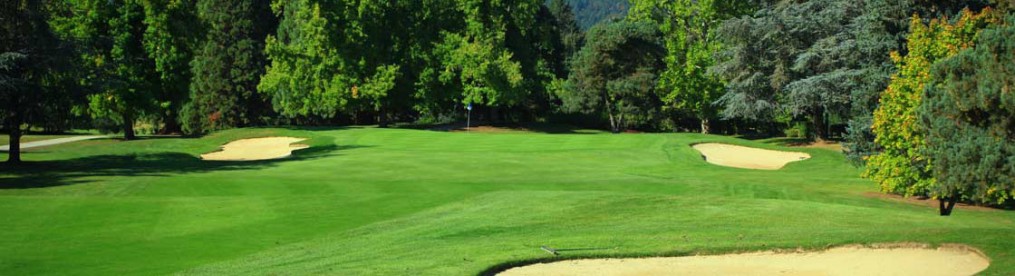
Perspective from the 19th Hole is the title I chose for my personal blog, which is meant to give me an outlet for one of my favorite crafts – writing – plus to use an image from my favorite sport, golf. Out of college, my first job was as a reporter for the Daily Astorian in Astoria, Oregon, and I went on from there to practice writing in all my professional positions, including as press secretary in Washington, D.C. for a Democrat Congressman from Oregon (Les AuCoin), as an Oregon state government manager in Salem and Portland, as press secretary for Oregon’s last Republican governor (Vic Atiyeh), and as a private sector lobbyist. This blog also allows me to link another favorite pastime – politics and the art of developing public policy – to what I write. I could have called this blog “Middle Ground,” for that is what I long for in both politics and golf. The middle ground is often where the best public policy decisions lie. And it is where you want to be on a golf course.
I have been familiar with discussions of miracles from my youth when I grew up in a Christian family, which honored such miracles as Jesus rising from the dead after a dreadful death.
His resurrection was truly a miracle. And other miracles are described in the 66 books of today’s Bible.
But, in many places today, the subject of miracles ends up being controversial. The question: What is difference between a supposed miracle and a coincidence?
To those who believe in miracles – including me – the question boils down to a simple, yet profound, word: Choice. I choose to believe. Some choose not to believe?
In this context, I was interested in what I have heard about action the Vatican takes to define miracles for the Catholic Church. Google provides good information on the subject, as follows:
The Vatican uses a multi-tiered, rigorous scientific and theological investigation primarily overseen by the Dicastery for the Causes of Saints to certify miracles, which are most commonly sudden medical healings.
1. Local Investigation
- Initial Report: The process begins at the local diocese level, where a bishop collects testimonies, medical records, and physical evidence from witnesses.
- Intercession Requirement: Investigators must confirm that the person who experienced the healing prayed solely for the miracle.
2. The Medical Board
- Independent Review: The case moves to the Vatican, where a panel of roughly 100 medical experts and physicians (some of whom are not Catholic) review the files.
- Strict Criteria: To pass this stage, the healing must be:
- Instantaneous or sudden
- Complete and permanent, not a temporary remission
- Organic and scientifically unexplainable given current medical knowledge
- Two-Thirds Majority: Under reforms introduced by Pope Francis, at least two-thirds of the medical board must vote to affirm that the cure has no natural medical explanation.
3. Theological and Commission Review
- Theological Evaluation: If the doctors rule out natural causes, a commission of theologians evaluates the event to ensure it represents a true sign of divine intervention rather than a coincidence.
- The “Devil’s Advocate” Role: A designated official actively searches for alternative explanations, natural causes, or flaws in the testimony to test the claim’s integrity.
4. Papal Approval
- Final Sign-off: The findings are sent to the Cardinals and officials of the Dicastery, and ultimately presented to the Pope, who makes the final decision to officially declare the event a miracle.
- Sainthood Milestones: Generally, one verified miracle is required for beatification (making a person “Blessed”), and a second verified miracle is required for canonization (making a person a “saint”), though exceptions can be made by the Pope.
All this said, my view, again, is this: I choose to accept the fact that God has the power to engage in miracles . The most significant one was when Jesus rose from the dead.
Plus, even though I am not a Catholic,I applaud the Vatican for the rigor of its process.

