
TWO APPROACHES TO “THEOLOGY:” ONE TO ADMIRE, ONE TO DISDAIN

[PERSPECTIVE FROM THE 19TH HOLE: This is the title I chose for my personal blog, which is meant to give me an outlet for one of my favorite crafts – writing – plus to use an image from my favorite sport, golf. Out of college, my first job was a reporter for the Daily Astorian (in Astoria, Oregon) and I went on from there to practice writing in all of my professional positions, including as an Oregon state government manager and a private sector lobbyist. This blog also allows me to link another favorite pastime – politics and the art of developing pubic policy – to what I write. If you are reading this, thanks for doing so and please don’t hesitate to respond so we can engage in a dialogue, not just a monologue.]


I was struck the other day by reading opinion pieces in the Wall Street Journal that compared two competing “theologies,” if that word even applies in one case.

One piece – hard to affix the label “theology” — dealt with Donald Trump and his apparent appeal to some have called the “religious right.”

The second dealt with former President Jimmy Carter and his incredible, personal and theologically-based approach to the reality that he now faces a cancer fight, at 90 years of age, for his life.

Let me put it simply: There is much to admire about Carter’s approach; there is much to disdain about Trump’s.

Consider this opening paragraph from columnist Frank Bruni as he wrote about the “theology of Donald Trump:”

Let me get this straight. If I want the admiration and blessings of the most flamboyant, judgmental Christians in America, I should marry three times, do a queasy-making amount of sexual boasting, verbally degrade women, talk trash about pretty much everyone else while I’m at it, encourage gamblers to hemorrhage their savings in casinos bearing my name and crow incessantly about how much money I’ve amassed?”

Then, for contrast, look only to a piece by another columnist, Leonard Pitts, who knows real Christianity when he sees it.

Pitts wrote: You did not hear much about faith last week when Jimmy Carter held a press conference to reveal that he has four spots of cancer on his brain. The 39th president made only a few references to it in the nearly 40 minutes he spoke, and they were all in response to reporter’s questions. Yet, you would be hard-pressed to find a more compelling statement of belief in things not seen.

“Unsentimental, poised and lit from within by an amazing grace, Carter discussed the fight now looming ahead of him, the radiation treatments he will undergo, the need to finally cut back on his whirlwind schedule. He smiled often. “I’m perfectly at ease with whatever comes,” he said, in such a way that you believed him without question. And it was impossible to feel sorry for him.”

Okay, Mr. Carter is not for running for president this time around, but, if he were, I would vote for him in a nanosecond compared with Trump (and notice that I don’t convey respect for Trump by using the title Mr.).

He is a terrible candidate for president when what this country needs is real people who will propose real solutions to real problems and, all the while, exhibit real faith.
PLAYING GOLF AT THE RIGHT PACE, NEITHER TOO SLOW NOR TOO FAST

[PERSPECTIVE FROM THE 19TH HOLE: This is the title I chose for my personal blog, which is meant to give me an outlet for one of my favorite crafts – writing – plus to use an image from my favorite sport, golf. Out of college, my first job was a reporter for the Daily Astorian (in Astoria, Oregon) and I went on from there to practice writing in all of my professional positions, including as an Oregon state government manager and a private sector lobbyist. This blog also allows me to link another favorite pastime – politics and the art of developing pubic policy – to what I write. If you are reading this, thanks for doing so and please don’t hesitate to respond so we can engage in a dialogue, not just a monologue.]

One of the headaches for those who hope golf, as a sport, can claim a larger audience is the fact that the game can be so slow.

That, plus the hours it takes to get in 18 holes – often four hours, if not more – makes it difficult to attract new devotees.

With this background, I was interested to read a piece by James Achenbach, who is retiring after many years as a writer for Golf Week magazine.

“Show play is one of golf’s biggest enemies,” he wrote, “but two club pros in the western United States deserve mention for leading the campaign to rid it from golf as if it were a malignant weed.”

Achenbach proceeded to highlight the efforts of the two club pros. One, Dick Hyland, head professional at The Country Club in DC Ranch in Scottsdale, Arizona, says fast golf is a way of life. He likes to play an 18-hole round each week with a different member of his club. As a twosome, they ride, are the first out on a given day and get around 18 holes in under two hours.

The other club pro, J.D. Ebersberger, co-founder of The Palms Golf Club in La Quinta, California, established three hours and 15 minutes as the target time for completing 18 holes.

As these two stories indicate, there are a number of ways to speed up golf, even if, as I do, you often walk 18 holes, which translates into about five miles. Always be ready to play when it is your turn. Figure out your yardage before it is your turn. When you get over your ball, take no more 15 seconds to hit a shot.

All of this argues against mimicking golf on the PGA Tour where players take much longer to play than they should. Slow play can become pattern for new players. Of course, the pros are playing for a lot of money, but, still, their example is not one to follow.

Golf can be a pastime for a lifetime, as it is for me. Good to be outdoors, getting exercise and playing a game that can tax your physical and mental strength. Just play faster.

And this footnote: It also is possible play golf too fast, thus ignoring the beauty of the surroundings and the pace of the game played well. To use a hackneyed phrase, stop and smell the roses.

In sum, play at a good pace, neither too slow nor too fast and enjoy the pastime that has captured the imagination of players for the ages.

PLAYING GOLF THE RIGHT PACE, NEITHER TOO SLOW NOR TOO FAST

[PERSPECTIVE FROM THE 19TH HOLE: This is the title I chose for my personal blog, which is meant to give me an outlet for one of my favorite crafts – writing – plus to use an image from my favorite sport, golf. Out of college, my first job was a reporter for the Daily Astorian (in Astoria, Oregon) and I went on from there to practice writing in all of my professional positions, including as an Oregon state government manager and a private sector lobbyist. This blog also allows me to link another favorite pastime – politics and the art of developing pubic policy – to what I write. If you are reading this, thanks for doing so and please don’t hesitate to respond so we can engage in a dialogue, not just a monologue.]

One of the headaches for those who hope golf, as a sport, can claim a larger audience is the fact that the game can be so slow.

That, plus the hours it takes to get in 18 holes – often four hours, if not more – makes it difficult to attract new devotees.

With this background, I was interested to read a piece by James Achenbach, who is retiring after many years as a writer for Golf Week magazine.

“Show play is one of golf’s biggest enemies,” he wrote, “but two club pros in the western United States deserve mention for leading the campaign to rid it from golf as if it were a malignant weed.”

Achenbach proceeded to highlight the efforts of the two club pros. One, Dick Hyland, head professional at The Country Club in DC Ranch in Scottsdale, Arizona, says fast golf is a way of life. He likes to play an 18-hole round each week with a different member of his club. As a twosome, they ride, are the first out on a given day and get around 18 holes in under two hours.

The other club pro, J.D. Ebersberger, co-founder of The Palms Golf Club in La Quinta, California, established three hours and 15 minutes as the target time for completing 18 holes.

As these two stories indicate, there are a number of ways to speed up golf, even if, as I do, you often walk 18 holes, which translates into about five miles. Always be ready to play when it is your turn. Figure out your yardage before it is your turn. When you get over your ball, take no more 15 seconds to hit a shot.

All of this argues against mimicking golf on the PGA Tour where players take much longer to play than they should. Slow play can become pattern for new players. Of course, the pros are playing for a lot of money, but, still, their example is not one to follow.

Golf can be a pastime for a lifetime, as it is for me. Good to be outdoors, getting exercise and playing a game that can tax your physical and mental strength. Just play faster.

And this footnote: It also is possible play golf too fast, thus ignoring the beauty of the surroundings and the pace of the game played well. To use a hackneyed phrase, stop and smell the roses.

In sum, play at a good pace, neither too slow or too fast and enjoy the pastime that has captured the imagination of players for the ages.

LOBBYING 101: COMMENTS ON AN HONEST PROFESSION

[PERSPECTIVE FROM THE 19TH HOLE: This is the title I chose for my personal blog, which is meant to give me an outlet for one of my favorite crafts – writing – plus to use an image from my favorite sport, golf. Out of college, my first job was a reporter for the Daily Astorian (in Astoria, Oregon) and I went on from there to practice writing in all of my professional positions, including as an Oregon state government manager and a private sector lobbyist. This blog also allows me to link another favorite pastime – politics and the art of developing pubic policy – to what I write. If you are reading this, thanks for doing so and please don’t hesitate to respond so we can engage in a dialogue, not just a monologue.]

One of my old teachers used the phrase “best fact first” when it came to writing. So, it may not be wise to start with the bad news because the approach can leave that news intact before getting to the better news. But so be it. In this post, I start with the negative.

The title lobbyist often conjures up negative images these days and I have nearly 40 years of experience hearing all of the bad stuff, not to mention media coverage that suggests all lobbyists are out to fleece the public.

Here are some fables about what all lobbyists do:

  • They carry around a bag of money and use the paper to buy results.
  • They have no respect for accuracy and resort only to overstatement and threats.
  • They plays fast and loose with facts to get their way on matters that should be related to the public interest, not private gain.

Well, that is not my experience. I functioned as a private sector lobbyist for almost 25 years and that experience came on top of another 15 years for government agencies where one of the my responsibilities was to relate to elected officials.

I was able to do this job, not perfectly of course, but with fealty to honesty and integrity. To get my way, I never lied or created false information.

I represented my clients, keeping their best interests in mind, with an eye, at the same time, to the public interest.

One credential was patently clear to me after 40 years in the business: Your word is your bond. If that was not true, you were in trouble, your credibility was at stake and so was the reputation of your clients.

When I told my mother about what I did for a living, I often resorted to three descriptions. First, I said, I was like an attorney; I had a client, had a contract to represent that client and my “courtroom” was the Capitol where I would meet with legislators.

Second, I said I was like a trader on a busy commodity-trading floor. Figuratively speaking, I had to yell to get an elected official’s attention with a lot of competitors.

Third, I was like a salesperson. I was not selling a car, a home or a widget. I was selling ideas – a perspective from client that would be affected by passage or failure of a specific piece of legislation.

So, take it from me, even with my bias, lobbying is an honorable profession. F course, there are those who don’t act in an honest and forthright fashion. But, most lobbyists act with a “your word is your bond” ethic and, thus, deserve respect as key players in the process of making public policy.

THE TRUMP PHENOMENON: REAL OR IMAGINED?


            [PERSPECTIVE FROM THE 19TH HOLE: This is the title I chose for my personal blog, which is meant to give me an outlet for one of my favorite crafts – writing – plus to use an image from my favorite sport, golf. Out of college, my first job was a reporter for the Daily Astorian (in Astoria, Oregon) and I went on from there to practice writing in all of my professional positions, including as an Oregon state government manager and a private sector lobbyist. This blog also allows me to link another favorite pastime – politics and the art of developing pubic policy – to what I write. If you are reading this, thanks for doing so and please don’t hesitate to respond so we can engage in a dialogue, not just a monologue.]

Why does Donald Trump continue to rise in the polls as America looks forward to the 2016 presidential election?

Perhaps there is no one answer to that question, but one factor is that many Americans are fed up with the current nature of politics and the failure of any of the elected class to deal genuinely with the real problems facing this country.

Put me in that camp of the disgruntled.

But, that said, there is no way that I could sign on to support Trump. His so-called “ideas” are outlandish and he couldn’t achieve them even if he was king for day. He blunders on, saying anything and everything, content, it would appear, to boost his own substantial ego.

If someone like me wants to help produce a better political process oriented to making tough decisions on tough public policy problems, the path to that process does not go through Trump.

Consider his immigration notions. He wants to deport all of those who are immigrants, including the children of immigrants who were born here. He couldn’t do that without changing the U.S. Constitution and that would take a political agreement that is not in the cards.

It would take years and millions of dollars to round up all of the immigrants around the country and throw them out, an action which would disrupt families and sow nothing but discord in a country where welcoming immigrants is a long-held position.

Still, Trump blunders on. And it seems that most members of the media giving him a pass as they appear willing to accept by his egotistical, bombastic style with no test of accuracy or ability to achieve.

Wall Street Journal columnist Peggy Noonan, not content to join other members of her craft, went deeper this week with a piece entitled, “America is so in play.”

She pointed to several factors that have given rise to Trump:

  • One is the deepening estrangement between the elites and the non-elites in America. This is the area in which Trumpism flourishes.
  • Second, Mr. Trump’s support is not limited to Republicans, not by any means.
  • Third, the traditional mediating or guiding institutions within the Republican universe — its establishment, respected voices in conservative media, sober-minded state party officials — have little to no impact on Mr. Trump’s rise. Some say voices of authority should stand up to oppose him, which will lower his standing. But Republican powers don’t have that kind of juice anymore. Mr. Trump’s supporters aren’t just bucking a party, they’re bucking everything around, within and connected to it.
  • Fourth, “the base” isn’t the limited, clichéd thing it once was; it’s becoming a big, broad jumble that few understand.

Noonan adds that, on the subject of elites, she spoke to Scott Miller, co-founder of the Sawyer Miller political-consulting firm, who is now a corporate consultant. He worked on the Ross Perot campaign in 1992 and knows something about outside challenges.

Miller, Noonan wrote, views the key political fact of our time as this: “Over 80 per cent of the American people, across the board, believe an elite group of political incumbents, plus big business, big media, big banks, big unions and big special interests—the whole Washington political class—have rigged the system for the wealthy and connected. It is ‘a remarkable moment.’ More than half of the American people believe ‘something has changed, our democracy is not like it used to be, people feel they no longer have a voice.

“People who work for a living are thinking this thing is broken, and that economic inequality is the result of the elite rigging the system for themselves. We’re seeing something big.”

Noonan ends her piece with this: “An odd thing, in my observation, is that deep down the elite themselves also think the game is rigged. They don’t disagree, and they don’t like what they see — corruption, shallowness and selfishness in the systems all around them. Their odd anguish is that they have no faith the American people can — or will — do anything to turn it around. They see the American voter as distracted, poorly educated, subject to emotional and personality-driven political adventures. They sometimes refer to “Jaywalking,” the old Jay Leno “Tonight Show” staple in which he walked outside the studio and asked the man on the street about history. What caused the American Civil War? Um, Hitler? When did it take place, roughly? Uh, 1958?

“Both sides, the elites and the non-elites, sense that things are stuck.

“The people hate the elites, which is not new, and very American. The elites have no faith in the people, which, actually, is new. Everything is stasis. Then Donald Trump comes, like a rock thrown through a showroom window, and the molecules start to move.”

I am among those who have believed that the preoccupation with Trump would not last. I have thought he would implode, but he already has lasted longer than I thought he would.

Therefore, Noonan’s analysis makes sense to me. But I hope that Americans who are fed up with the status quo will opt for something more genuine than Trump.

We need real people who will debate real problems and come up with real solution

IMMIGRATION ON THE FRONT BURNER, BUT IT’S NOT A NEW ISSUE

[PERSPECTIVE FROM THE 19TH HOLE: This is the title I chose for my personal blog, which is meant to give me an outlet for one of my favorite crafts – writing – plus to use an image from my favorite sport, golf. Out of college, my first job was as a reporter for the Daily Astorian (in Astoria, Oregon) and I went on from there to practice writing in all of my professional positions, including as an Oregon state government manager and a private sector lobbyist. This blog also allows me to link another favorite pastime – politics and the art of developing pubic policy – to what I write. If you are reading this, thanks for doing so and please don’t hesitate to respond so we can engage in a dialogue, rather than just my monologue.]

To read some news accounts recently, you’d think that immigration policy was a new issue.

It’s not.

Would-be policymakers in Washington, D.C. ( I write would-be because they have not actually come up with a policy) and states along the border between the U.S. and Mexico have struggled with the issue for years, with no solutions in mind, perhaps in part because we are a nation of immigrants; at least my generation’s forbears were.

Donald Trump, who deals in overstatements, even said in early August on the presidential campaign trail (yes, it is incredible that the blowhard is viewed these days as a genuine candidate for the nation’s highest political office) that “this was not a subject that was on anybody’s mind until I brought it up at my announcement.”

Absurdly, Trump even advocated two so-called “policy innovations:” Abolition of birthright citizenship and mass deportation.

Many reporters let that Trump’s inaccuracies ride, but New York Times columnist Charles Krauthammer would not be still. He performed a service by putting Trump’s comments in a context, with these points, under a telling headline – Borderline Lunacy:

THROWING OUT BIRTHRIGHT CITIZENSHIP: If you are born in the United States, Krauthammer reminds readers that “you are an American citizen.” That’s because the 14ttth amendment to the Constitution exists. Rounding up and deporting all of the citizens, mostly children, who were born of immigrant parents, admittedly many of them illegals, would require years of work and millions, perhaps billions, of dollars in costs.

MASS DEPORTATION: Trump told NBC reporters that “all illegal immigrants must leave the country, along once they’ve been kicked out, we’ll let the good ones back in.”

“On its own terms,” Krauthammer writes, “this is crackpot. Wouldn’t it save a lot just on Mayflower moving costs if you chose the ‘good ones’ first – before sending SWAT teams to turf families out of their homes, loading them on buses and dumping them on the other side of the Rio Grande.”

“Less frivolously,” Krauthammer adds, “it is estimated by the conservative American Action Forum that mass deportation would take about 20 years and cost about $500 billion for all the police, judges, lawyers and enforcement agents – and bus drivers! – needed to expel 11 million people.

“This would all be merely ridiculous if it weren’t morally obscene. Forcibly evict 11 million people from their homes? It can’t happen. It shouldn’t happen. And, of course, it won’t ever happen. But because it’s the view of the Republican front-runner, every other candidate is now required to react. So instead of debating border security, guest-worker programs and sanctuary cities – where Republicans are on firm moral and political ground – they are forced into a debate about a repulsive fantasy.”

WHO BENEFITS FROM TRUMP’S EGO-DRIVEN BOMBAST? THE DEMOCRATS: If you are a conservative alarmed at the country’s direction and committed to retaking the White House, Krauthammer says you should be concerned about what Trump’s ascendancy is doing to the chances of that happening.

“The Democrats’ presumptive candidate is flailing badly,” Krauthammer writes. “Republicans have an unusually talented field with a good chance of winning back the presidency. Do they really want to be dragged into the swamps — right now on immigration? – that will make that prospect electorally impossible?”

As a footnote, Oregonian columnist David Sarasohn added his voice to the debate over the weekend when he wrote a piece on the immigration debate, with an emphasis on Oregon.

“It was always hard to figure out the logistics,” Sarasohn writes, “of just how more than 100,000 undocumented immigrants in Oregon were going to quickly shipped out of the country…There would be the matter of tens of thousands of Oregon families being taken apart, and large part of the Oregon economy ceasing to exists, but, hey, we’re about a principle here.”

Point made.

Responding to the writing of Krauthammer and Sarasohn, this writer hopes that we will find a better way to have debates about critical issues facing this country, including immigration.

We need rationale, moral, thoughtful people who will vie to lead this country where ALL of us reside.

PRESIDENTIAL CONTEST HEATS UP ON BOTH — NO, ALL — SIDES

[PERSPECTIVE FROM THE 19TH HOLE: This is the title I chose for my personal blog, which is meant to give me an outlet for one of my favorite crafts – writing – plus to use an image from my favorite sport, golf. Out of college, my first job was as a reporter for the Daily Astorian (in Astoria, Oregon) and I went on from there to practice writing in all of my professional positions, including as an Oregon state government manager and a private sector lobbyist. This blog also allows me to link another favorite pastime – politics and the art of developing pubic policy – to what I write. If you are reading this, thanks for doing so and please don’t hesitate to respond so we can engage in a dialogue, rather than just my monologue.

Here we are still a few months away from the presidential primary and all we see are continuing horse-race stories about the contest on both sides – Democrat and Republican – or even a third side, Independent.

It’s possible that the result could boil down to a tough choice for voters between an alleged crook on one hand and a blowhard on the other. The alleged crook is Democrat Hillary Clinton, who is under continuing scrutiny for use of personal e-mail accounts to do the public’s business. The blowhard – not necessary to use the word “alleged” in this case – is Republican Donald Trump, who appears to believe he can say anything because any comment will buttress his already massive ego.

Clinton, for her part, is coming under increasing scrutiny for her use of a private e-mail account, including, allegedly, to handle classified material when she was Secretary of State. She also appeared to use that high office to create windfalls for the Clinton Foundation.

It is possible, as this is written, that Vice President Joe Biden will enter the D fray, an action which could be good news for Senator Bernie Sanders if Biden’s entry takes already eroding support away from Clinton.

But, for now, back to the Republicans.

With only media accounts on which to rely, it is difficult to sift and sort through all of the candidates, especially with so many — too many for one debate — in the race.

Wall Street Journal columnist Gerald Seib performed a service a couple weeks ago when he wrote a piece dividing the Republican candidates into two camps after the first debate – fighters and statesmen.

His piece asked the question: Do voters want a candidate who channels their anger, or one who acknowledges it yet moves beyond it? Seib added: It says something about the national mood of 2016 that it isn’t entirely clear which is the better place to land.

Seib put Donald Trump, Rand Paul, Chris Christie and Mike Huckagee in the fighter camp.

While those candidates, Seib wrote, were engaged in a kind of debate demolition derby, there was another group that seemed more interested in a calmer drive down the political parkway.

In this calmer camp, he put Jeb Bush, Marcio Rubio, Scott Walker and John Kasich. Seib added that three candidates relegated to the early debate on Fox – Carly Fiornia, Rick Perry and Bobby Jindal – might find a way to gain some traction heading toward Iowa.

What works best – fighting or statesmanship? There is no agreement this far in advance of the 2016 primaries.

From the Seib column: “The fight camp is about dividing folks, like Obama has done,” said Scott Reed, who managed Bob Dole’s 1996 presidential campaign and now directs political operations for the U.S. Chamber of Commerce. “Statesmen are more about growth–growing the party and being upbeat and optimistic about the future.”

Similarly, Kevin Madden, who worked on Mitt Romney’s 2012 campaign, says “these races ultimately always shift towards becoming a contest of who is the most presidential.”

Finally, Seib says there is a question about whether anyone can bridge the fighter and statesmen camps. So far, there has been no answer to that question and the answer probably won’t emerge until Donald Trump exits stage left, for he is, at best, an actor playing a part – and here’s hoping the departure occurs soon.

RE-VISITING OREGON’S ASSISTED SUICIDE LAW

[PERSPECTIVE FROM THE 19TH HOLE: This is the title I chose for my personal blog, which is meant to give me an outlet for one of my favorite crafts – writing – plus to use an image from my favorite sport, golf. Out of college, my first job was as a reporter for the Daily Astorian (in Astoria, Oregon) and I went on from there to practice writing in all of my professional positions, including as an Oregon state government manager and a private sector lobbyist. This blog also allows me to link another favorite pastime – politics and the art of developing pubic policy – to what I write. If you are reading this, thanks for doing so and please don’t hesitate to respond so we can engage in a dialogue, rather than just my monologue.]

A Wall Street Journal opinion piece the other day recalled for me difficult memories of the time, 20 years ago, when Oregonians voted to approve the first doctor assisted suicide measure in the country.

The headline on the piece illustrates the writer’s point of view: A Doctor-Assisted Disaster for Medicine.

Further, the writer, Dr. William L. Toffler, an Oregon physician who heads Physician for Compassionate Care, said he “had seen the dire effect of assisted-suicide laws on patients and my profession.”

For me, the piece brought to mind these facts:

THE FIRST CAMPAIGN: My firm, CFM Strategic Communications, ran the opposition campaign the first time the measure appeared on the ballot. It was a hard-fought campaign and, as you might imagine, featured themes that tugged at the emotions of Oregonians on both – if not all – sides of the debate.

The result was that Oregonian approved the measure by a 51-49 vote, which as the margin indicates, could not have been predicted by any reputable pollster.

THE LEGISLATIVE RESPONSE: It was tough for many legislators to understand the implications of this first-in-the-nation law, so, in a difficult decision, they sent the measure back out to a vote of the people. Even after “the people spoke,” legislators asked them to speak again – and they did, this time by a clear 60-40 margin. [It should be added that my firm did not run that second campaign.]

A FURTHER LEGISLATIVE RESPONSE: What follows next is a tribute to the ability of a legislature to rise to the occasion and develop a compromise that reflects true middle ground – no one is 100 per cent in favor of the compromise, but everyone gets something even while losing something.

This was the case when the legislature took on the task of revising the “immunities” section of the law that had recently cleared the ballot.

Tough work.

The task was assigned to then Senator Neil Bryant, R-Bend, a seasoned legislator with the ability to find the smart middle ground and lead his colleagues in the Senate and the House to accept the decision.

He called various interests into a back room, including representatives of the assisted suicide advocacy group, Oregon Right to Die, and me, as the representative of Oregon’s largest health care system, Providence Health & Services.

Further, in a wise move, Bryant specifically prohibited the Oregon Catholic Conference from participating in the negotiations because it would have been impossible for the religious organization to compromise on an issue of faith and principle.

Over several weeks we hammered out a compromise that allowed organizations like Providence, which were affiliated with a religious organization, to prevent assisted suicide “on their property, by their employees, and within the course and scope of contractual arrangements.”

In return, Providence had to agree to a tough corollary – it had to refer patients out for information and services related to assisted suicide. And, for some, referral is tantamount to “agentry,” which is viewed as being almost the same as engaging in the immoral action itself. For a health care provider, however, it made sense to accept the compromise in light of the new Oregon law, as well as the obligations to meet the needs of ALL patients.

IMPLEMENTING THE LAW: In his Wall Street Journal piece, Dr. Tofler says that more than 850 persons have taken their lives by ingesting massive overdoses of barbiturates prescribed under the law.

Proponents, he says, claim the system is working well with no problems. He disagrees.

“As a professor of family medicine at Oregon Health & Science University in Portland, as well as a licensed physician for 35 years, I have seen firsthand how the law has changed the relationship between doctors and patients, some of whom now fear that they are being steered toward assisted suicide.

“As a society, we should continue to reject the legalization of physician-assisted suicide as a solution to suffering. Instead, we must work to increase access to hospice and palliative care to better support those suffering from terminal illness. The sick and aging deserve better than Oregon’s mistake.”

WHAT’S AHEAD: The debate over assisted suicide is clearly not over, though the law in Oregon is not likely to change. Anyone who has been involved with loved ones or friends in the late stages of their lives can understand the interest in the poignant and emotional decisions near the end, including in the midst of suffering. At the same time, Dr. Tofler’s personal experiences propose the notion that physicians should focus on life, not death.

All of these tough issues will arise again to the south as the state of California considers an assisted suicide measure. The venue will be the California legislature where the outcome is in doubt, given religious opposition, hesitant Democrats and question marks from Governor Jerry Brown who says a special session is not the place to consider such a weighty decision.

CELEBRATING A 25TH ANNIVERSARY WITH WILLAMETTE VALLEY VINEYARDS

CELEBRATING A 25TH ANNIVERSARY WITH WILLAMETTE VALLEY VINEYARDS

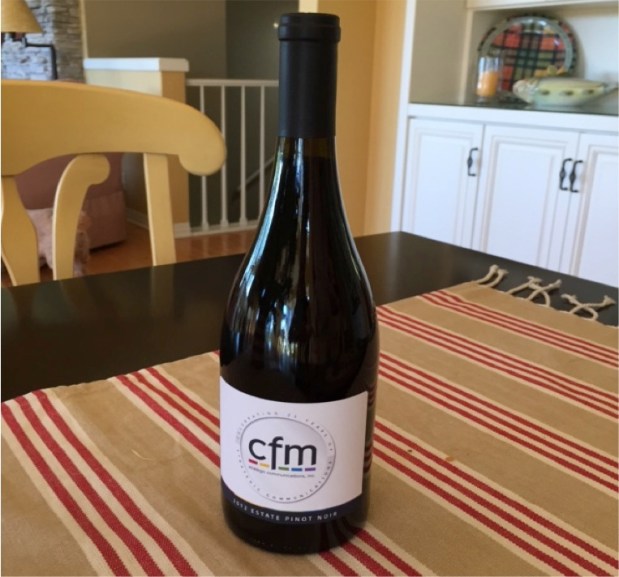
CFM wine bottleThe firm where I worked for 25 years – CFM Strategic Communications – celebrated its 25th anniversary this month by hosting a wine pairing dinner at Willamette Valley Vineyards (WVV), one of Oregon’s premier winemaking enterprises.

Actually, the president of WVV, Jim Bernau, hosted us at his establishment just south of Salem in the hills near I-5, a location which affords incredible views to the west, including the initial grapevines, which Jim planted himself about 30 years ago.

Jim, one of the most capable entrepreneurs I know, offered various reports over dinner about the wine industry in Oregon, which has prospered over the years. He peppered his comments with stories of the public policy achievements over the years by Oregon wineries, as well as about specific results by the industry in being environmentally friendly.

That was interesting news for all of us at CFM because, over the years, we have had the privilege of representing the Oregon Winegrowers Association at the Capitol in Salem, often with Jim chairing the committee with which we worked. So, we share with Jim and many other winemakers credit in Oregon for passing laws in that have allowed the industry to flourish here.

The WVV mission statement says it all: “Our mission in growing cool-climate varietals is to create elegant, classic Oregon wines from the Willamette Valley Appellation. As native Oregonians, we treasure our environment and sustainable practices in vinifying our winegrapes.”

As reported in the WVV website, Bernau, “purchased the estate site in 1983 and cleared away,” by his own hand, “the old pioneer plum orchard hidden in scotch broom and blackberry vines. He planted Pinot Noir (Pommard and Wadenswil clones), Chardonnay (Dijon and Espiguette) and Pinot Gris.  In the beginning, he hand-watered the vines with thousands of feet of hose.

“Numerous classes at UC Davis, and seminars from here to France, sharpened Jim’s viticultural skills and in 1989 he was ready to build his dream–a world class winery in the Willamette Valley—and make cool-climate varietals, especially Pinot Noir, in sufficient quantities to be served and sold in the best restaurants and bottle shops in the world.

“A combination of determination and extraordinary people has brought Willamette Valley Vineyards from an idea to one of the region’s leading wineries, earning the title “One of America’s Great Pinot Noir Producers,” from Wine Enthusiast Magazine…

“The winery and underground cellar are carved into the top of an ancient volcanic flow, the soil red from its oxidized iron content and well-drained. This unique terroir is similar to the red clay soil found in the Grand Cru Pinot Noir vineyards of Romaneé-st-Vivant in Burgundy, where the ‘soil gives France’s most perfumed, satiny, expensive wine.’”

Thus, the award winning Willamette Valley label.

We have been honored to share many of our 25 years with Jim and his colleagues, plus to enjoy wine and dinner at his fine establishment earlier this month.

If you get a chance, visit the winery yourself. You’ll be impressed by the location, the service – the best in the business in my judgment – and, of course, the fine wine.

So, Jim, here’s to another 25 years!

If you get a chance, visit the winery yourself. You’ll be impressed by the location, the service – the best in the business in my judgment – and, of course, the fine wine.

So, Jim, here’s to another 25 years!

WORDS MATTER — OR DO THEY?

[PERSPECTIVE FROM THE 19TH HOLE: This is the title I chose for my personal blog, which is meant to give me an outlet for one of my favorite crafts – writing – plus to use an image from my favorite sport, golf. Out of college, my first job was a reporter for the Daily Astorian (in Astoria, Oregon) and I went on from there to practice writing in all of my professional positions, including as an Oregon state government manager and a private sector lobbyist. This blog also allows me to link another favorite pastime – politics and the art of developing pubic policy – to what I write. If you are reading this, thanks for doing so and please don’t hesitate to respond so we can engage in a dialogue, not just a monologue.]

I have always said there are three kinds of people when it comes to receiving information in today’s society…

  • Those who like words
  • Those who like pictures and other graphics
  • Those who like numbers and charts

Of course, there are variations on the themes, as well as combinations of all three.

Those who know me know that I like words better than the other “stuff.” For this blog, I’ll focus on the power of using certain words in certain circumstances – or, given the first example, ignoring the simple meaning of words on their face.

That example is the U.S. Supreme Court. In its recent decision upholding the federal ObamaCare health care law, justices on the prevailing side appeared to ignore four key words in the Affordable Health Care Act: “Established by the state.”

The words were contained in the long and complicated health are act that cleared both the U.S. House and Senate without one Republican vote on the “yes” side. The four words were meant to indicate that federal tax credits would be available only to citizens who received their health care through STATE health insurance changes.

Of course, since enactment of the law, most states have passed on creating exchanges – or, in the case of Oregon, failed to do so successfully.

If it was a drafting error for the four words to be included in the Health Care Act, well the fact is that the words were there and they were there several times. In theory at least, they mean what they say. But, the Supreme Court ruled differently and, in the process, some critics said it was legislating, not opining on the meaning of a law.

The Court vote allowed the federal act to remain in place without leaving those who had applied for and/or received tax credits to continue on down the tax credit road. Was it a political move? I would say yes.

Was it the right move on the simple meaning of the words? I would say no and, while I am not attorney, I have focused on the meaning of words in all of my professional live and believe the decision ignored the direct meaning of the statute.

Let’s move on to a more mundane example, but one that illustrates an important point, at least for me. If, in writing a piece, you say that someone admitted something, you convey an impression, upon close reading, that someone did something wrong and admitted the wrongdoing.

However, if you use a more neutral word – the word said, for instance – you don’t leave the impression of guilt. I first learned this valuable lesson when I was a reporter for a daily newspaper, The Daily Astorian. In covering city and county government in that coastal community, I tried to use the neutral word in attributing quotes or paraphrases.

Words also matter when it comes to euphemisms, which exist throughout society, both in writing and speaking. On occasion, there are good reasons for euphemisms – better sometimes to pull the punch than deliver the news, sometimes bad news, more directly.

But, in politics, where I spent 40 years of my professional career, euphemisms are often used to blur the reality of an action. Look no farther than the phrase “revenue enhancement” instead of the phrase “tax increase.” The former blurs the reality, often I suggest, intentionally.

Or, the word government “investment” rather than the word government “spending.” The former makes sense if the expenditure actually produces a return on the expense – then it truly is an investment. But, more often than not, the word investment is used to blur the reality that some in government want to spend more money without regard to a return.

In a letter to the editor of the Wall Street Journal early this month, a writer made a few more points, some of which are worth noting:

  • “Investment” means spending
  • “Access to” means free
  • “All of the e-mails” means all of the e-mails I want you to see
  • “Refundable tax credit” means a handout
  • “Fairness” means theft

Thus, the writer adds, going back to my first example, why should anyone expect the U.S. Supreme Court to read “state” as state or “legislators” as legislature?

So, in a number of ways, words matter, especially to those of us who focus first on them rather than on charts, graphs or pictures.

The message is: Try to use the right words, understand what the words mean and be careful about the impressions you convey when using them.